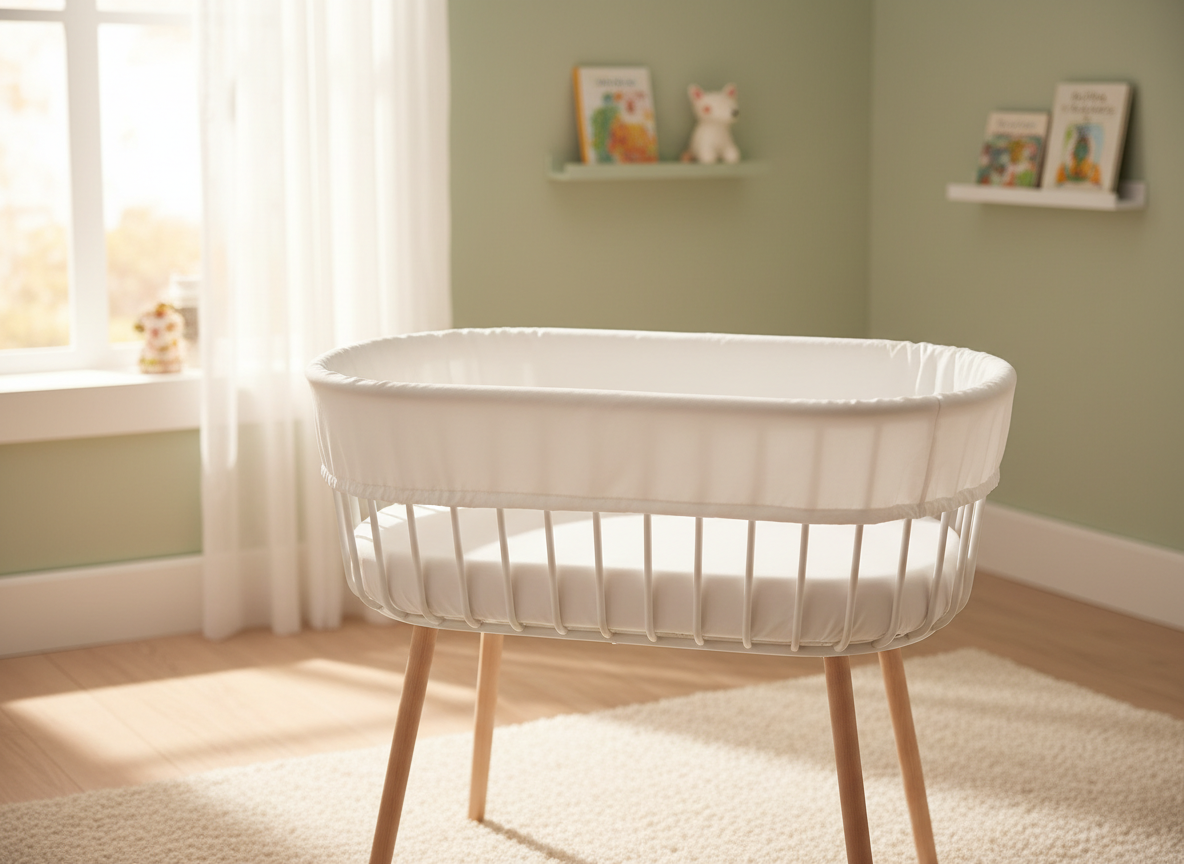
A bassinet keeps a newborn close and cozy during the first months, whether beside your bed or in another room. Choosing one involves more than style: safety, size, and how long it will be useful all matter. This guide explains safe sleep basics, the features to compare and how to know when it is time to move on.
As an Amazon Associate, we earn from qualifying purchases. Some links on this page are affiliate links, so we may earn a commission at no extra cost to you. We have not tested these products; this guide is general information, not medical advice. Always follow the manufacturer’s instructions and your pediatrician’s guidance.
Key takeaways
- Babies should sleep on their backs on a firm, flat surface with no loose bedding, bumpers or soft toys.
- Look for a stable base, a firm snug mattress and breathable sides.
- Bedside bassinets make night feeds easier, but follow the attachment instructions exactly.
- Most bassinets are outgrown within a few months, so plan to move to a crib.
Safe sleep comes first
Pediatric guidance, such as that from the American Academy of Pediatrics, recommends that babies sleep on their backs on a firm, flat surface, with no loose blankets, pillows, bumpers or soft toys. Whatever bassinet you choose:
- Check that it meets current safety standards in your country, and look for any recall notices before buying or using it.
- Use only the mattress and fitted sheet made for that bassinet.
- Follow the weight and age limits in the manual.
- Keep the bassinet on a flat, stable surface and away from cords, blinds and other hazards.
- Do not use an inclined or cushioned surface for unsupervised sleep.
What to look for in a bassinet
Stable, sturdy base
The bassinet should not tip or wobble when touched. A wide base and locking mechanisms add stability.
Firm mattress and snug fit
The mattress should be firm, flat and fit snugly with no gaps at the sides.
Breathable sides and visibility
Mesh panels allow airflow and let you see your baby easily.
Size and portability
Measure the space in your bedroom. Some bassinets are compact, fold for storage or have wheels or a stand that can be moved. Check that wheels lock.
Bedside design
Bedside bassinets attach or sit close to your bed so night feeds are easier. Follow the manufacturer’s instructions for attaching them.
Extras
Rocking motion, vibration, sound and lights are optional and add cost. If included, make sure they can be turned off.
Washable fabric
Removable, machine-washable covers make cleaning easier.
How long will a bassinet last?
Bassinets have weight limits and developmental limits. Many manufacturers advise stopping use once a baby starts pushing up on hands and knees or rolling, which can happen at a few months of age. Check your model and plan to transition to a crib. Our guide to choosing a baby crib can help when the time comes.
Buying a bassinet secondhand
Used bassinets can save money but carry risks. Only consider one if you can confirm it has not been recalled, is undamaged, includes all parts and the instruction manual, and comes with its original mattress.
Bassinet checklist
- Meets current safety standards in your country
- No recall notices
- Stable base with locks
- Firm, snug mattress
- Breathable sides
- Fits your space and budget
Frequently asked questions
Is a bassinet necessary?
No, some parents use a crib from the start. A bassinet is a smaller, portable option for the early months.
Can my baby sleep in a bassinet all night?
Yes, if the model is designed for it and used according to instructions.
Can I add a blanket or bumper?
Safe sleep guidance advises against loose bedding and bumpers.
How do I clean it?
Follow the care label; many covers are machine washable.
Bassinet vs crib: which should I choose?
A bassinet is smaller and easier to keep beside your bed for the first months. A crib lasts longer. Many families start with a bassinet and move to a crib.
When should a baby stop using a bassinet?
Check the manual for your model. Many advise stopping when the baby reaches the weight limit or starts rolling or pushing up on hands and knees.
Related baby guides
- How to choose a baby crib: safety checklist and features
- How to choose diapers: sizing, fit and skin sensitivity
- How to choose a bed rail for toddlers
See more nursery guides in our household category.