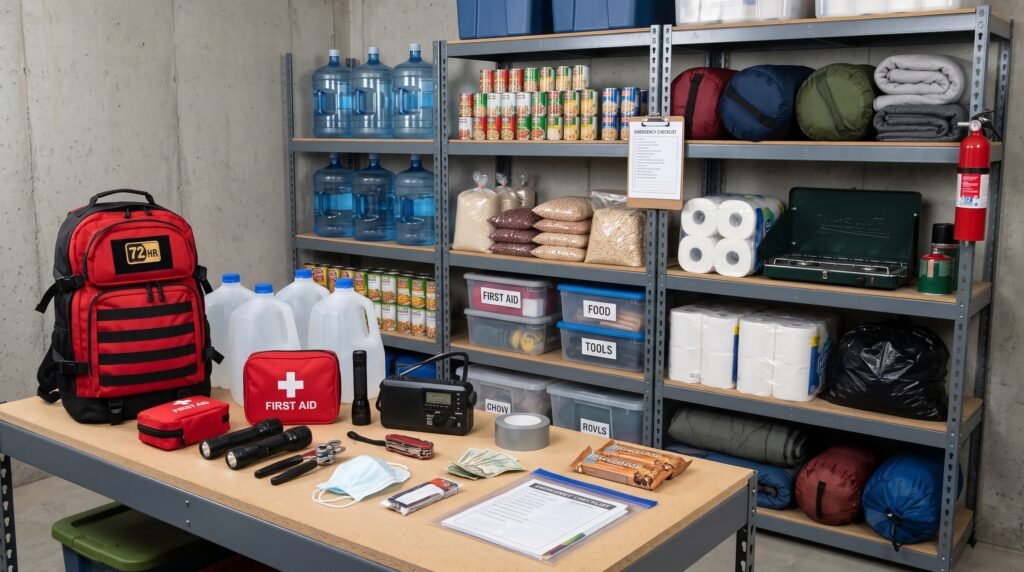
An emergency supplies checklist is much easier to build once you know how many days you are planning for. In late October 2026, the UK and Japan asked households to keep at least three days of supplies at home, and a report about 90-day off-grid planning for US military bases set off a wave of online posts about stockpiling for three months. This guide separates what officials actually recommend from what is only being discussed online, then gives you a tiered checklist for a 3-day (72-hour) emergency kit and for 7, 14, 30 and 90 days, plus a free printable PDF and links to browse each category on Amazon.
As an Amazon Associate, we earn from qualifying purchases. Some links on this page are affiliate links, so we may earn a commission at no extra cost to you. We have not tested these products; details come from the product listings and from the official guidance linked under Sources.
Last updated: November 5, 2026
Quick answer: how many days of emergency supplies do you need?
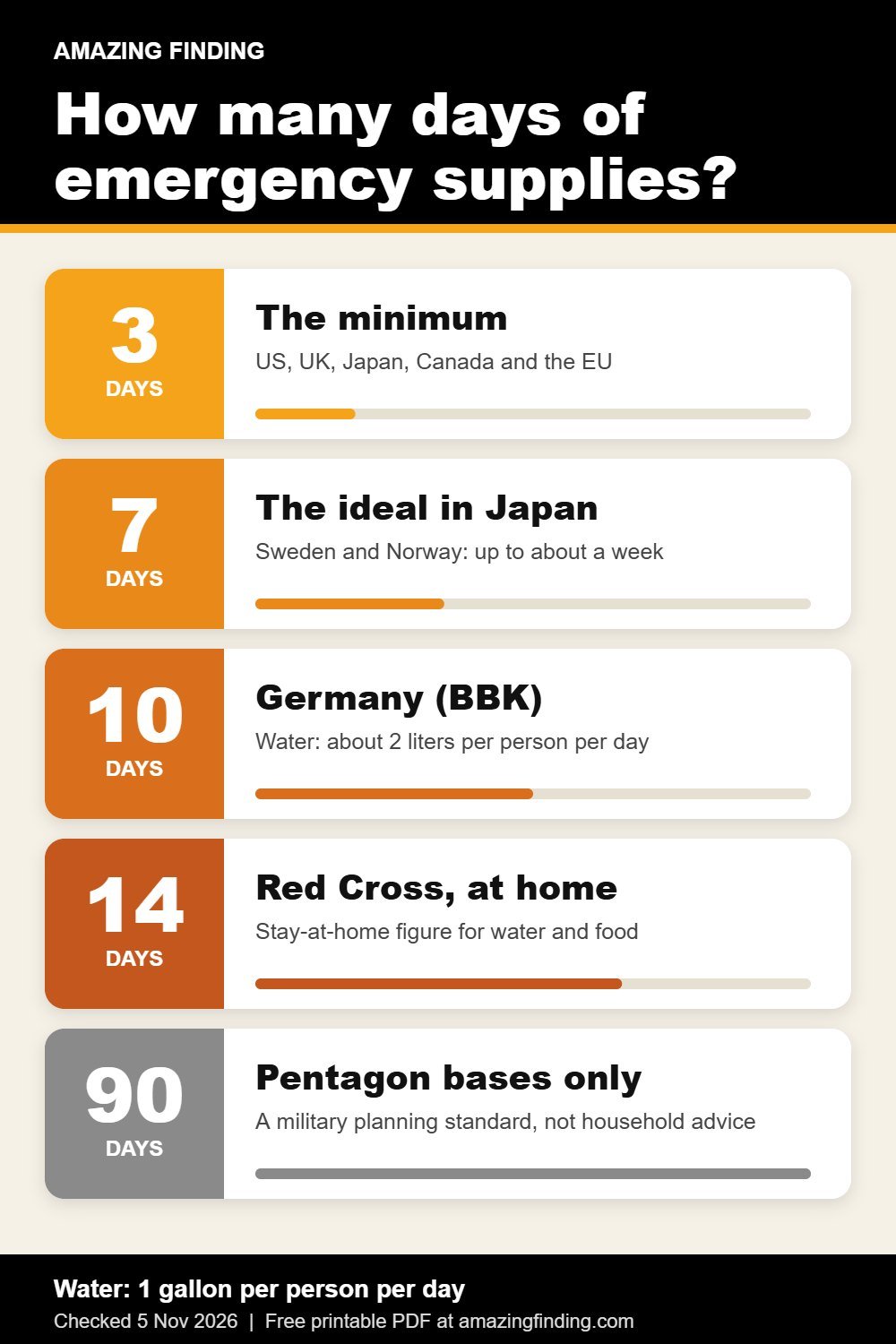
For most households, official guidance centers on three days as the minimum and one to two weeks as a stronger target. If you only do one thing, build a 3-day kit, then add a little each time you shop until you reach 7 to 14 days. Plan for 30 days or more only if you have the storage space, the budget and a way to rotate food before it expires. We did not find any government that asks ordinary households to keep 90 days of supplies.
- 3 days (72 hours): the minimum in the US, UK, Japan, Canada and the EU.
- 7 days: Japan’s “ideally a week,” and the Swedish and Norwegian guidance.
- 10 days: Germany’s BBK target.
- 14 days: the Red Cross figure if you stay at home.
- 30 days: optional, if you have the space and a rotation habit.
- 90 days: a Pentagon planning standard for military bases, not household advice.
What governments and relief groups actually recommend
Recommendations differ by country, but they cluster around three days to ten days. The table below uses the official pages and news reports listed under Sources, and the numbers were checked on 5 November 2026. Agencies update their pages, so check the current version before you rely on a figure.
| Source | Recommended supply | Notes |
|---|---|---|
| American Red Cross | 3-day supply if you may need to evacuate; 2-week supply if you stay at home; 7-day supply of medications | Water: one gallon per person per day |
| US FEMA and Ready.gov | At least 3 days of non-perishable food and one gallon of water per person per day | Reported figure; the guidance has not changed because of the 90-day news |
| UK “Be Ready” campaign (launched 22 October 2026) | 3 days; about 3 liters of drinking water per person per day | Also food that needs no cooking, torch, power bank, battery or wind-up radio, cash, documents |
| Japan (announced for 2 November 2026) | At least 3 days, ideally a week | Food, water and toilet supplies, according to the disaster management minister |
| Germany (BBK) | 10 days; about 2 liters of drinking water per person per day (20 liters each for 10 days) | The brochure says 3 days already helps and that you can build up gradually |
| Sweden and Norway | Up to about one week | As reported in news coverage of the 2026 stockpiling advice |
| European Union (March 2025) | At least 72 hours | France, Canada, the Netherlands and Mexico are also reported at about 3 days |
| US Department of Defense | 90 days of self-sufficient operation (power, water, fuel, communications) | A planning requirement for military bases, not household advice |
Do you need 90 days of emergency supplies? Where the number came from
The 90-day figure comes from the military, not from household guidance. Fortune reported on 26 October 2026 that the Pentagon is developing a requirement for major US military installations to keep essential operations running for at least 90 days without outside support. Defense Secretary Pete Hegseth announced the wider FORTRESS initiative on 30 September. About 500 bases are being assessed, and a senior official said full implementation could take decades.
Reader’s Digest makes the same point: the 90-day standard applies to bases, Ready.gov still recommends a several-day supply, and people should be skeptical of posts urging three-month stockpiles, especially when the poster is selling something. That applies to us too, since we earn a commission on links, which is why we say plainly that most households do not need 90 days.
Is the US government telling people to stock up for 90 days? No. According to Fortune, President Trump issued a National Preparedness Month message in September urging Americans to keep emergency kits, but Ready.gov’s household advice still calls for several days of supplies, as Reader’s Digest notes. Preparing for a longer outage at home is your choice, not a government request.
Why is everyone talking about stockpiling right now?
The timing explains the buzz. The UK launched its Be Ready campaign on 22 October, Japan announced its own request ahead of 2 November, and NewsBytes reported that UK searches for “emergency kit” rose 180% on 23 October and “emergency candles” rose over 5,000% two days later, citing Google Trends. Officials cite severe weather, cyber incidents and supply-chain disruption. The UK Defence Secretary said he wants people to be “alert but not alarmed”, and the aim is to cope with a temporary disruption while waiting for help.
Google Trends shows the same pattern in the US. Searches for “stockpile food” jumped from near zero to their peak in late October and had fallen most of the way back by 4 November, while searches for “emergency kit” stayed above their early-October level (Google Trends, US, past 30 days, checked 5 November 2026). The rising related searches were questions, such as why people are being asked to stockpile food and whether you need to stock up. The practical lesson is that news spikes fade quickly, so build supplies steadily instead of in one panic shop.
You may also see a claim online that 33 countries are telling their people to stockpile. We could not confirm that count, and the official advice we checked ranges from about 3 days to 10 days. Reports say governments do not expect a war or major disaster to be imminent: the advice is meant to help households cope with a temporary disruption while they wait for help.
Do you need to stock up on food right now?
You do not need to empty the shelves. Start with three days of food and water you would actually eat, then add a few items on each shop. Grocery costs and storage space are real limits, and Reader’s Digest advises readers to be skeptical of social media posts urging three-month stockpiles, especially when the poster is selling something.
What foods to stockpile
- Canned fish, meat, beans, vegetables and fruit
- Rice, pasta and oats
- Peanut butter, nuts and dried fruit
- Crackers and other shelf-stable snacks
- Foods you already eat, so nothing goes to waste
- Pet food, and ready-to-feed formula if you have a baby
What to stock first if you are worried about war, a cyberattack or a long outage
Official advice does not include a separate kit for war. Government guidance treats storms, power cuts, supply-chain disruption and other emergencies with the same basic kit. If a long outage or conflict worries you, spend in this order: water, food that needs no cooking, medicines and first aid, warmth, light, a radio and charged power banks, then cash and documents. Skip “doomsday” gear marketing until those are done.
Quick planning math for one person
The US figure of one gallon of water per person per day (about 3.8 liters) covers drinking and basic sanitation. The UK uses about 3 liters per day for drinking alone and Germany about 2 liters, so the US figure is a sensible planning number. For food, about 2,000 calories per adult per day is a common planning figure; children, older adults and people with medical needs differ.
| Days | Water at 1 gallon per day | Food at about 2,000 calories per day | Realistic for most homes? |
|---|---|---|---|
| 3 | 3 gallons (about 11 liters) | About 6,000 calories | Yes, fits in one bag and one shelf |
| 7 | 7 gallons (about 26 liters) | About 14,000 calories | Yes, one pantry shelf and a few water jugs |
| 14 | 14 gallons (about 53 liters) | About 28,000 calories | Yes, with some planning and a storage corner |
| 30 | 30 gallons (about 114 liters) | About 60,000 calories | Needs dedicated space and a rotation habit |
| 90 | 90 gallons (about 340 liters) | About 180,000 calories | Rarely; plan to purify water rather than store it all |
The 10 essential items in an emergency kit (and a 20-item list)
People often ask for the 10 most important items. This short version is built from the Red Cross and UK lists.
- Water: one gallon per person per day
- Non-perishable food that needs little or no cooking
- A flashlight or headlamp, with extra batteries
- A battery-powered or hand-crank radio
- A first aid kit
- Regular medications (the Red Cross suggests a 7-day supply)
- A phone charger and a charged power bank
- Sanitation and hygiene items
- Cash and copies of important documents
- A multi-purpose tool and a manual can opener
The 20-item emergency kit list
For a fuller list, add these ten.
- An emergency blanket and warm clothing
- Trash bags
- Toilet paper and wet wipes
- Dust masks or N95 respirators, if you choose to keep them
- A printed list of family and emergency contacts
- Maps of your area
- Hand sanitizer
- Food and water for pets
- Baby supplies, if you need them
- A carbon monoxide detector and a fire extinguisher
The emergency supplies checklist by tier
Each tier builds on the last. Finish one before you start the next, and buy foods you already eat, since the UK checklist suggests choosing foods you would usually eat.
Tier 1: the 3-day (72-hour) emergency kit checklist
- Water: one gallon per person per day for 3 days, plus extra for pets
- Food that needs no cooking or refrigeration, enough for 3 days
- A flashlight or headlamp with spare batteries (the UK checklist says torches are safer than candles)
- A battery-powered or hand-crank radio
- A charged power bank and phone cables
- A first aid kit and a 7-day supply of regular medications, as the Red Cross suggests
- Sanitation and hygiene items, including wipes, toilet paper and trash bags
- Cash in small bills and coins, since card payments and ATMs can fail
- Copies of IDs, insurance papers and a printed list of phone numbers
- A blanket or warm layers; for babies, ready-to-feed formula, diapers and wipes
Tier 2: 7-day emergency supplies
- Double the water and food from Tier 1, and add foods you can eat cold
- A manual can opener, since electric ones stop working in an outage
- An outdoor-only cooking method, such as a camping stove with matching fuel
- A second light source and spare batteries
- Pet food and any special dietary food
- Request prescription refills early; the UK checklist says at least five working days before you run out
Tier 3: the 14-day emergency kit list (the Red Cross at-home figure)
- Shelf-stable staples such as rice, pasta, oats, beans, peanut butter, and canned fish, vegetables and fruit
- Water storage containers, plus a filter or purification tablets as a backup
- Emergency toilet supplies and more trash bags
- More first aid supplies, plus respirator masks if you choose to keep them
- A battery-powered carbon monoxide detector and a fire extinguisher
- Warm bedding and clothing for your climate, and games or books for morale
Tier 4: 30-day emergency food and water (a 4-week supply)
- A written rotation system: label items with the buy date and use the oldest first
- Larger food reserves, with long shelf-life meals as a backup
- More fuel for cooking, stored safely and outside living space, following local rules
- Water treatment capacity for the whole household, not just stored water
- A backup plan for charging phones and medical devices
Tier 5: 90-day emergency supplies
Few households need this tier. It makes sense only if Tiers 1 to 3 are done, you have space and budget, you can rotate food, and you live somewhere long disruptions are plausible, such as a remote area with severe winters. At this size you should plan a way to get and treat water, because storing 90 gallons per person is impractical. Talk to your doctor or pharmacist about medication supply, since you cannot simply stock extra of a prescription.
Free printable emergency supplies checklist (PDF)
Print the checklist, tick each box as you stock it, and keep it with your kit. It covers the 3, 7, 14, 30 and 90 day tiers, the planning math and the safety reminders above, on two pages.
Recommended products to stock
These buttons open Amazon search results for each category; they carry our Associate tag, so a qualifying purchase supports this site at no extra cost to you. We list what to look for rather than specific models because we have not tested them, so compare current listings, ratings and return policies before you buy.
Water storage and treatment
Choose food-grade containers with a tight lid and a spigot or pour spout, and never reuse containers that held chemicals. Replace water you bottle yourself about every six months. For filters and tablets, check each listing for what it is rated to remove and follow the label.
If you get advance warning of a storm or outage, a bathtub liner can hold a large amount of clean drinking water. Check the listing for capacity and instructions before you rely on it.
Food and cooking
Favor ready-to-eat or quick-cook foods you would normally eat, and keep a manual can opener with them. If you cook with a camping stove, use it outdoors only and buy fuel that matches the stove.
For infants, ask your pediatrician which formula and how much to store, and never give honey to a baby under one year old.
Light, power and radio
A headlamp keeps your hands free, and a lantern lights a room. Add a radio that does not need wall power and a charged power bank. Our AA batteries guide explains how to choose batteries for these devices.
Warmth
Plan for warmth that does not need electricity. A heated blanket needs power, so our heated blankets guide is better for everyday comfort than for outages.
First aid, hygiene and sanitation
Match the first aid kit to your household size and add personal items. If you keep respirator masks, check the packaging for approval markings and fit. Toilet bags and trash bags are easy to forget until you need them.
Safety devices and documents
A battery-powered carbon monoxide detector matters most when you use backup heat or cooking. Keep copies of documents in a waterproof pouch with your cash.
How to build your supplies without spending a lot at once
- Week 1: water, a flashlight and a radio
- Week 2: three days of food you already eat, plus a can opener
- Week 3: first aid, sanitation items and copies of documents
- After that: add two or three extra items to every grocery trip until you reach 7 to 14 days
- Write the date on everything and rotate the oldest items into your normal meals
Safety rules that matter more than gear
- Carbon monoxide: the CDC says never run generators, grills or other gasoline, propane or charcoal devices inside a home, garage or carport. Keep generators at least 20 feet from doors, windows and vents, and never heat your home with a gas oven.
- Food in the fridge: a closed refrigerator keeps food cold for about 4 hours, a full freezer for roughly 48 hours and a half-full freezer for roughly 24 hours. Never taste food to judge whether it is safe.
- Candles: the UK checklist favours torches over candles for safety.
- Medicines: ask your doctor or pharmacist how to keep a safe reserve of regular medication.
Frequently asked questions
How many days of emergency supplies should you have?
Three days is the common minimum in the US, UK, Japan, Canada and the EU. The Red Cross suggests two weeks if you stay at home, and Germany suggests ten days. Start with three days, then build to seven to fourteen.
Are we supposed to stock up for 90 days?
No. The 90-day number comes from a Pentagon planning standard for military bases, and we found no government that asks households to match it. A 7 to 14 day supply is a sensible target for most households and matches the Red Cross at-home figure.
Do we need to prepare for 90 days without power?
Not according to official household guidance, which runs from about 3 days to 14 days. If you live somewhere remote or face long winter outages, you can plan longer, but finish the 3, 7 and 14 day tiers first.
Why are people stocking up on food and water right now?
Government preparedness advice, including from the UK, got fresh news coverage in late October 2026, and a report about the Pentagon’s 90-day planning for military bases spread online at the same time. See the section on why everyone is talking about stockpiling for the details.
What are the 10 items you need for an emergency kit?
Water, food, a flashlight with batteries, a radio, a first aid kit, medications, a charger and power bank, sanitation items, cash and documents, and a multi-purpose tool with a manual can opener. The full list is above.
How many days should an emergency kit last?
A go-bag is a portable 3-day kit for evacuation. A home supply is larger and, per the Red Cross, is sized at two weeks for staying put.
What is the 3-3-3 rule for survival?
It is usually called the rule of threes: roughly 3 minutes without air, 3 hours in a harsh environment, 3 days without water and 3 weeks without food. Wikipedia calls it a rule of thumb, not precise science, but it explains why emergency plans start with water and shelter.
How much water do I need per person per day?
Plan on one gallon (about 3.8 liters) per person per day in the US, which covers drinking and basic hygiene. The UK suggests about 3 liters for drinking, and Germany about 2 liters. Increase it for hot weather, illness, nursing and pets.
What should I stockpile for WW3 or a war?
There is no official “war kit.” Governments recommend the same basics for every scenario: water, food, medicines, light, a radio, power banks, warmth, cash and documents. Build those first, calmly and over time.
What is the difference between a go-bag and a home supply?
A go-bag is a portable 3-day kit for evacuation. A home supply is a larger store of water, food and fuel for staying put.
How often should I replace stored water and food?
Replace water you bottle yourself about every six months, and check dates on packaged food. Use the oldest items first so your stock rotates through your normal meals.
Is there a free printable emergency supplies checklist PDF?
Yes. Download our two-page printable checklist (PDF) for the 3, 7, 14, 30 and 90 day tiers.
Related guides on Amazing Finding
Sources
Checked on 5 November 2026. Official pages change, so confirm current figures with the agency.
- Fortune: Pentagon 90-day base planning and the UK Be Ready campaign (26 October 2026)
- Radio X: the UK Be Ready checklist (23 October 2026)
- Business Today: Japan and UK supply advice (27 October 2026)
- American Red Cross: Be Red Cross Ready factsheet
- German BBK: Vorsorgen für Krisen und Katastrophen (copy hosted by a municipality)
- Reader’s Digest: Should you keep 90 days of supplies?
- The Vibes: countries urging households to stockpile
- NewsBytes: UK search spikes after Be Ready update
- CDC: avoiding carbon monoxide poisoning
- WVU Extension: food safety during power outages
- Wikipedia: Rule of threes (survival)
- Google Trends: US searches for emergency kit and stockpile food, past 30 days (checked 5 November 2026)